weekly prompts 05 | the big company playbook, now available to everyone
the developer who thinks clearly about tradeoffs is more valuable than the one who follows the playbook

this is a tech section in experimental’s newsletter. if you prefer follow weekly prompts on linkedin & unfollow this section here on substack.
march 15th, 2026
hi guys! welcome to another weekly prompts (:
today’s rambling is on what a solo developer can execute now....
this edition is basically a live example of it:
migrating infrastructure, launching a satellite product, and reworking market positioning simultaneously...
while freelancing and exploring vietnam,
not sure if all of that could be done simultaneously by one single person five years ago.
___
a quick note before we start: if you’re new here, so far we are kinda answering...
“where does software judgment come from?“
first edition covered ubiquitous language says it comes from talking to people, not just writing code;
second ed: the refactor vs. rebuild edition says it comes from honest assessment, not technical ego;
third ed: the architecture one says it comes from resisting borrowed complexity from big corp, being honest on how sometimes things can actually be simplified;
forth ed: the AI trust one says it comes from deciding how much uncertainty you’re willing to expose in your system.
so we have the same argument from four different angles: the developer who thinks clearly about tradeoffs is more valuable than the one who follows the playbook.
___
today idk, let’s just be brief and opinionated on modern stacks and marketing strategy.
let’s go (:
git diff -- vercel + supabase vs. railway
i’m testing a sub-product of leilão no mapa (the SaaS I’m building) this week and for that I’m using railway. i stumbled on this product while building the competitor analysis dashboard for a client, which I mentioned last week.
the cost is meaningfully cheaper, and railway runs on a canvas model: every service you have, your postgres instance, your app, your workers, whatever else, appears as a node you can visually connect.
internal communication between services happens over a private network by default, no extra config, no going through the public internet... for a solo dev running more than one project, the cognitive overhead of keeping infrastructure in your head is real, so this removes a layer of it. you look at the canvas and you just... see the thing lol
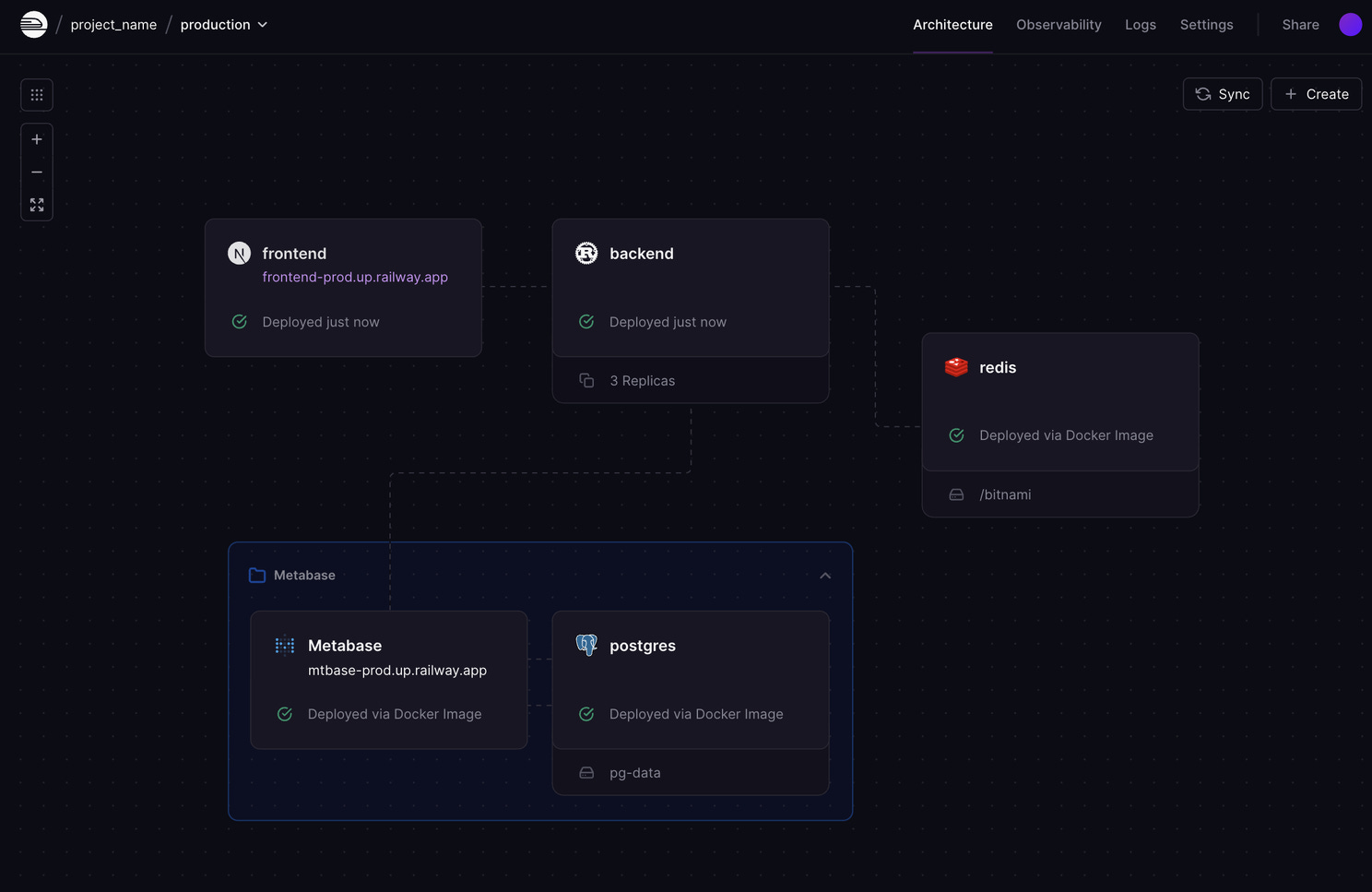
the pricing model also fits differently: vercel and supabase both have their own billing logic based on requests, bandwidth, database size. meanwhile railway charges for actual resource consumption, cpu and memory.
so the test of railway and possibly a full migration of the solution isn’t driven by a technical failure, this isn’t a verdict against vercel or supabase, but for where i am right now, I think that’s not the right fit anymore.
___
git branch -- one product becomes two
after a lot of user conversations about leilão no mapa, one thing became impossible to ignore: the juridical and compliance analysis of the real estate matricula is where people actually get stuck.
the matricula is the property registration document in brazil, and reading it correctly, knowing what to flag, what to look up next, is the real bottleneck in the market. my competitors have some tooling for this, but it’s buried inside chunky UIs.
so i’m testing analisematricula.com as a standalone product. not a feature inside leilão no mapa, just a separate thing. you paste or upload a matricula and it doesn’t just read it, it gives you next steps: check jusbrasil, search this on the web, here are the phone numbers you need... a shortcut for anyone buying, renting, or bidding at auction, but also useful for law firms and imobiliárias that do this dozens of times a month.
splitting products isn’t a new strategy, adobe has been doing it for years, launching focused standalone tools like adobe express and adobe sign instead of cramming every bet into creative cloud, for example.
now with AI solo developers can run the same playbook, not with the same resources ofc lol but with the same logic. i’m not certain splitting is the right call, maybe the answer is to keep everything in one place and explore UX approaches, but the user signal was clear enough that i want to test the hypothesis cleanly.
___
git stash -- making a boring market feel interesting
the other experiment: repositioning leilão no mapa. same product, different framing.
real estate auctions in brazil are genuinely associated with bureaucracy, confusion, and the faint feeling that something sketchy is going on. that reputation isn’t entirely wrong, which is part of what makes it interesting.
boring markets are often boring because nobody made the effort to explain them, and a market that nobody understands is one where the people with information profit over the people without it.
so, the audience i want to reach isn’t just the experienced investor hunting for a deal, it’s the person who has the money, who would otherwise end up in a lançamento na planta at inflated prices, or worse, buying something without understanding what they actually own...
real estate literacy in brazil is genuinely low, and that gap has real costs for people, so the strategy, if i can call it that, isn’t just about making leilão no mapa more appealing, it’s about reframing the buying experience itself as the product, not “here are auctions, good luck.” but “here’s what you need to understand to make a confident decision, here is a free deep explanation on what is what, and here’s the tool that helps you explore this world.”
the product doesn’t change much, the context does a bit, so I’m trying to frame something like where the product is obviously the right choice for a specific person in a specific context, and the context i want to own is financial literacy meets accessible real estate, not yet another auction aggregator competing on volume of listings, so I don’t need to compete with those solutions as well.
can i really do it? idk lol let’s test. whether the rebranding reflects that or not, i’ll find out when i try to write the copy and reaching people, that’s usually when you discover whether the idea actually holds, apparently.
for this week that’s all, thanks for reading s2
don’t be shy, let’s make linkedin less awkward, chime in on the comments (!)
until the next prompt, Michelle (: